Exhibited · INVENTX 2026
Latent Intersection
- Artifact
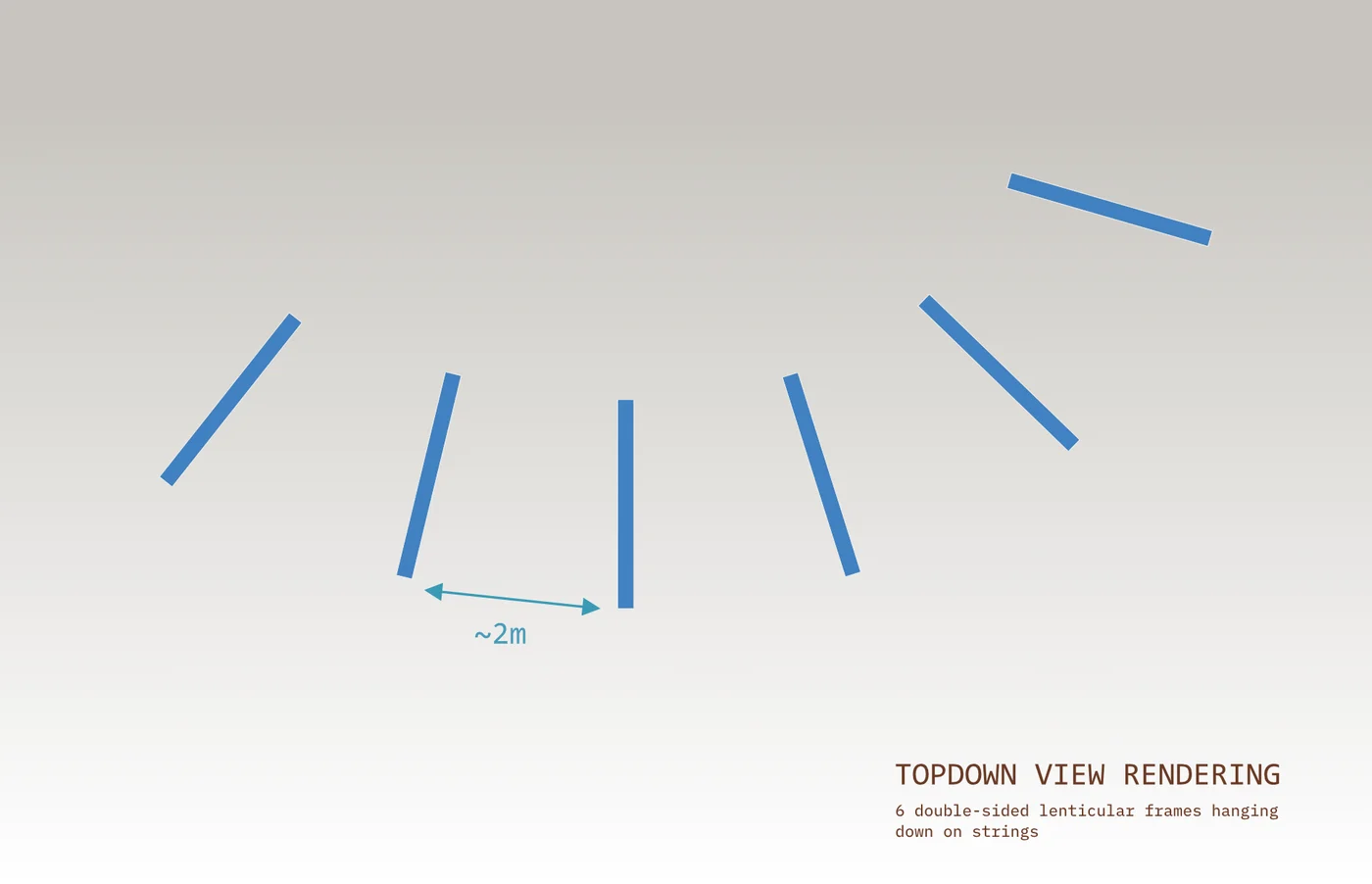
- Six suspended double-sided frames
- Images
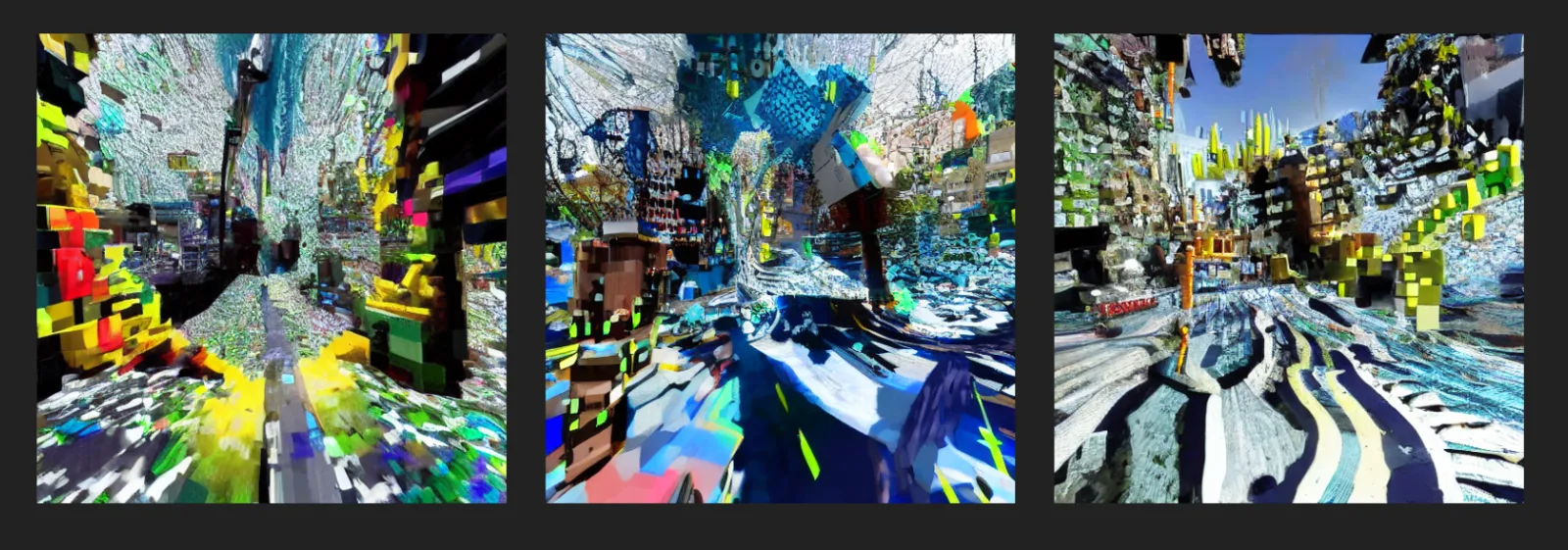
- Twelve 85 × 85 cm lenticular prints
- Exhibition
- 4th International INVENTX Creative Exhibition
- Dates
- 2 July–2 August 2026
- Recognition
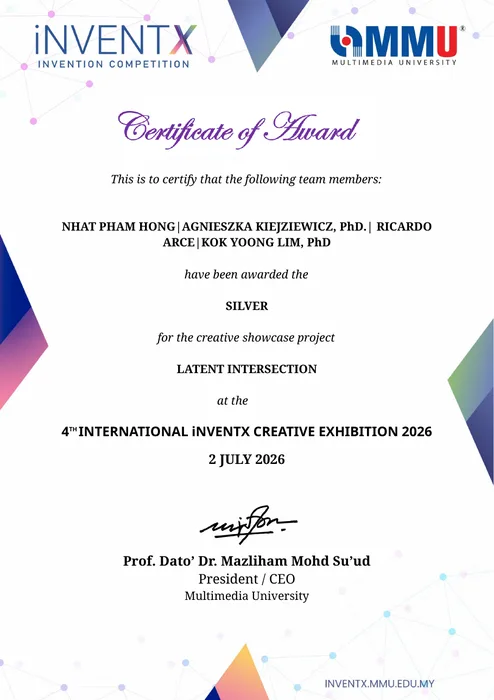
- Silver Award
Final artifact
Twelve final image surfaces, experienced through movement.
The archive contains the complete print sequence and an installation mockup. These are presented accurately as final prints and a spatial proposal, rather than on-site installation photography.
Companion materials
Full NTRO report
Latent Intersection
Nhat Pham Hong, Agnieszka Kiejziewicz, Ricardo Arce and Kok Yoong Lim · RMIT University Vietnam
Abstract
Latent Intersection is a series of generative AI lenticular prints depicting a sequence of a shifting generative AI landscape that is both familiar and uncanny. The series of lenticular prints is mounted on both sides across six frames, each measuring 85 × 85 cm, hung from the ceiling on a linear curving path, allowing viewers to approach and walk through the installation from different angles and observe the visualised multidimensional nature of AI latent space. The organisation of frames refers to the AI medium’s latent-space walk technique, which is the core of the gamified experience. Viewers become “latent space walkers”, an extension of the embodied abstraction of AI space, as they move through the frame sequence, explore, and make sense of the evolving, data-rich latent landscape at the threshold of uncanniness, situated between the known and the unknown. Thus, the artwork explores the potential of AI as an integral part of the creative process and medium by reconsidering AI uncanny hallucinations not as mere errors or technical failures, but as novel medium-specific expressions.
Aligned with the TAP-AI: Extension vs. Extinction theme, the work embraces AI uncanniness and instability as opportunities for novel discovery and sense-making within the contemporary zeitgeist of the networked paradigm as informed by Philip Galanter’s Complexism. Here, sense-making is a negotiated and collaborative process of networking among the triad of human/AI/viewer, prompting and reinterpreting the unfolding, abstracted landscape that defies absolutism. Situated within contemporary AI visual culture, Latent Intersection brings to the fore the emerging aesthetics of human-machine co-creation, and explores the shifting mode of seeing, interpretation, and spectatorship.
Keywords: generative AI; uncanny; procedural map; co-creation; latent space.
Artist’s statement
Concept and theme
The AI’s latent space’s “black box” nature and its emergent properties result from the interpolation of many data dimensions. Such emergence frequently results in what technical literature calls AI hallucinations: unintended, strange effects, visuals, and textures in image-generative AI (Leng et al., 2024). Hallucinations can induce uncanniness: the sense of something simultaneously intimate and strange, echoing Freud’s perception of the Unheimlich as a return of the familiar in defamiliarised form that teeters between the known and unknown and challenges interpretations (Bartnæs, 2009). It is at the edge of the uncanny that we step into the unknown, explore its potential, and map new possibilities. Thus, considering its algorithmic opacity as a medium, AI’s uncanniness materialises what it can hide, reveal, and process. Experimental approaches to AI’s emergent property are underexplored, while it offers promising new artistic expressions and perspectives across all creative fields and practices. To explore this uncharted potential creative medium, we created Latent Intersection, aiming to lay AI’s generative processes bare and embrace its strangeness as a human/AI/audience communicative and interpretive opportunity, bridging the gap into its “black box” latent space. By crossing the uncanny threshold, we question the boundaries of our understanding and possible outcomes with generative AI as a creative medium.
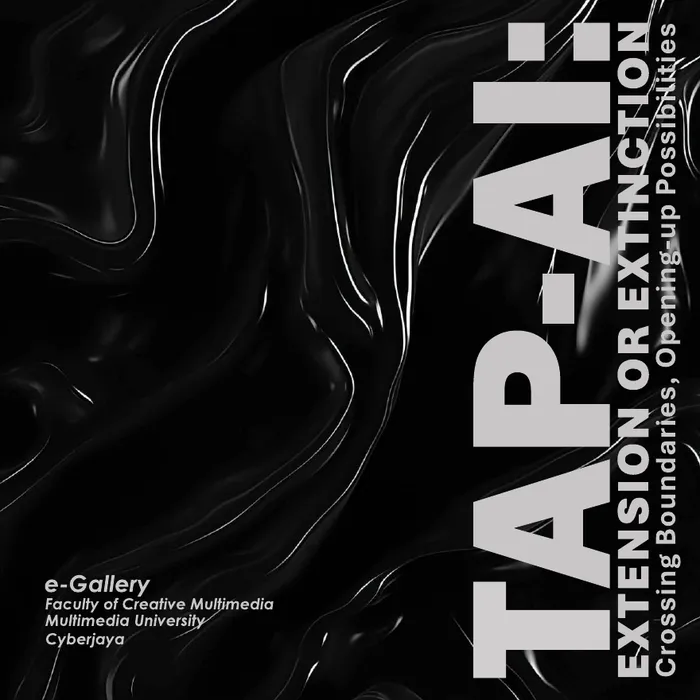
The artwork directly addresses the theme of TAP-AI: Extension or Extinction — Crossing Boundaries, Opening Up Possibilities by placing the viewer at the unstable, uncanny threshold, where time and space are mere interpolations and parts of the intersection of AI’s entangled, rich data web. To facilitate this, we brought AI latent space’s multidimensionality into the physical world through the printed medium, set up as a physical installation where six frames, each measuring 85 × 85 cm, are hung in a curving linear path. On each frame, two lenticular generative AI prints of a strange and uncanny landscape are mounted on the two sides of the frame, each a visual representation snapshot of the data interpolations within the AI’s latent space exposed through the latent-space walk technique developed in our previous project. As the viewers walk through and engage with the installation from different angles, it invites sense-making through its unstable grounding, prompting viewers to peer closer and examine these uncanny emergences and peek into the slices of the AI’s inner working system that defies visual absolutism. This act brings the visual representation of the multidimensional abstract latent space into the physical world, allowing the viewers to explore and understand this space in an embodied experience. Thus, the viewer becomes not just an observer, but an extension of the embodied abstraction of AI space, and an active seeker of meaning and stability at the unstable intersection of AI emergence.
The AI in Latent Intersection is seen as both the extension of human creativity and the co-creator of meaning. Echoing Lagerkvist’s notion of digital thrownness, the artist and viewer are beings-in-the-world thrown into a landscape that refuses total legibility, enabled by AI’s unique aesthetics of uncanny renderings and physical manifestation of the latent-space representation (Lagerkvist, 2018). This notion existed from the beginning of the creative process and extended into the final installation outcome. The AI becomes the interpreter of the artist’s text prompts, a source of novel expression, and hallucinates infinite uncanny data amalgamations derived from the prompts. The artist assumes the role of the curator, making sense of AI’s potential, reorganising and recontextualising AI’s data and hallucinations as ready-mades. The audience then joins the last part of this triadic meaning-making collaborative process. Each frame presents the same landscape differently, leaving the viewer’s sense-making indeterminate and constantly redefining itself as they move through the sequence of frames, reading and interpreting the AI-generated landscape and its shifting motions.
Creative approach and process
To bring out the AI’s uncanniness, we chose Stable Diffusion as our generative AI model for Latent Intersection. It is a source-available diffusion AI model capable of text-to-image generation with great control over the process. Stable Diffusion allows fine-tuning numerous parameters aside from the usual text prompt to control how the AI generates an image. Early iterations of the AI’s outputs were figurative, as the model itself is trained on massive databases of real-world photos. Initial results were not far from the atypical of the popular AI aesthetics that is overly polished yet unrefined and tried to stay close to clear references. The CFG scale (Classifier-Free Guidance Scale) is the parameter that dictates how closely the AI follows the input text prompts (Shen et al., 2024). We deliberately set the CFG scale to a low value and combined this with prompting to encourage deviation from both the prompt and the concrete concept or subject. Instead, we favoured strange and abstract results that are only possible using AI and not reproducible by humans using traditional means to induce uncanniness. Further fine-tuning can also be achieved through the usage and training of low-rank adaptation (LoRA) — a small and lightweight model that trains on a small selection of additional datasets outside the main Stable Diffusion model to transfer its learned dataset onto the latter efficiently (Quinn et al., 2020). LoRA was used in this project to train the model to generate the desired visual aesthetic consistently.
ComfyUI is crucial to the prototype’s visual development as it facilitates the creation and curation process. It is the front-end interface of Stable Diffusion that allows the design of the AI generative process through its node-based system. The completed setup of ComfyUI effectively describes the inner workings of the AI model through a flow chart made up of different nodes, allowing us to effectively automate and experiment with generative-AI-afforded medium-specific techniques critical to our visual exploration, like LoRA training and latent-space walking. The latent-space walking technique exploits the latent space’s interpolative nature, continuously sampling a point in latent space and incrementally changing the latent representation. The result is a series of outputs with pseudo-animation quality, providing a glimpse of the data points, their nuances, and their dimensions through interpolations. The technique implementation for Latent Intersection was derived from our earlier game-based experimentation, in which it was developed as a navigational process for players to traverse through AI’s interpolated representations. This allowed us to peer into a part of AI’s internal working and its data multidimensionality, reinterpret, curate them as ready-made, and rearrange them for the final artwork. Therefore, the AI in Latent Intersection became the creative medium and actively participated as a co-creator in the creative process.
Artistic interpretation and impact
Latent Intersection places the viewer at the unstable uncanny threshold, like an explorer before taking their steps into the ever-changing AI-generated landscape, both familiar and strange. It invites the viewer into the reciprocating cycle of sense-making within the trio of artist/AI/audience. Sense-making of the weird and uncanny becomes a negotiated process between the three agents in the networked loop, constantly in flux, resisting absolutism, and ebbing and flowing through each interpretative mental model.
We hope the work sparks the viewer’s curiosity for the technology and evokes a sense of wonder through the unfolding uncanny. The act of moving through the still-frame sequence lets the viewer perform a “latent space walk” in physical reality through the evolving generative AI landscape, inviting them to immerse themselves within AI’s uncanny emergence, explore, and gain an understanding of the nature of its data-rich latent space. We also call for the reflection of our relationship as co-creator and co-audience with the AI, with each the prompter and interpreter of meaning, exploring the technology’s potentials as a creative medium and expression beyond its original design intention as agents of mere technical efficiency and accuracy.
Materials and techniques
The artwork features a sequence of six double-sided AI-generated lenticular still frames — making twelve the total number of lenticular prints, each measuring 85 × 85 cm. These frames are hung from the ceiling in a curving linear path as a reflection of the work’s creative process and technique, the latent-space walk itself, allowing the audience to approach and weave in between the work from different angles (see Fig. 4). The specific sequence was chosen based on the outputs’ uncanny qualities and distinct aesthetics unique to AI generation, capturing its interesting and strange visual flourishes resulting from AI hallucinations while avoiding meaningless visual noise — data that strays too far from any visual anchor.
References and influences
Informed by Philip Galanter’s theory of Complexism (2016), this artwork responds to the contemporary zeitgeist of the networked paradigm, where systems and their agents interact and react to each other, creating chaotic yet deterministic results larger than the sum of their parts. By nature, AI — a complex network of artificial neurons in itself — is an inseparable agent of such a network, to which the creative practice must respond.
We were influenced by the modernist abstraction approach of blurring the line of concrete representations, breaking down reality into its bare essence. Moreover, the blurred boundary that resists absolute meaning or truth echoes Derrida’s theory of différance, in which he argued that meanings assert themselves only as being different from other signs. Therefore, absolute meaning is impossible, as meanings are constantly in flux and are relatively defined by their interconnection to other signifiers. Rather than arriving at fixed truth, AI’s emergence property reveals the underlying working of its latent space, or its truth, while also modulating its output based on the interpolations of relative multidimensional data points that elude our understanding. Together, these influences position our work within the complexist framework, contemplating an uncertain but intriguing future in which generative AI, artist, and audience revolve around a distributed network of negotiated meanings navigating the uncanny terrain of machine-mediated aesthetics.
Conclusion
Latent Intersection demonstrates how AI hallucinations can be expressed as unique and novel creative expression and challenges their original design intent as a tool for efficiency and replacing human agency. By exposing AI’s latent space and its unique uncanny aesthetics through the medium-specific processes, namely latent-space walking, the work explores the potential of generative AI as a creative medium and the boundaries of our understanding of this new medium. The work presents the threshold of uncanniness not merely as undesired errors or glitches, but as communication and interpretive opportunities that bridge towards the unknown and open a networked paradigm of negotiated meaning between the triad of the artist/AI/viewer. Hence, the work contemplates the human/AI relationship as co-creator and co-audience and its uncertain but exciting creative future.
The project can be further developed to become an interactive digital installation in the form of a game prototype, in which the player can directly traverse through the infinite uncanny AI landscape using gaming conventions (game controller or keyboard and mouse).
Acknowledgement and funding
This installation was created with the support of RMIT University in Vietnam. The creation of this artwork is supported by material and digital resources belonging to RMIT University, Vietnam.
References
- Bartnæs, M. (2009). Freud’s ‘The “Uncanny”’ and Deconstructive Criticism: Intellectual Uncertainty and Delicacy of Perception. English Studies, 12(1), 29–54. https://doi.org/10.3366/E1460823509000531
- Bergmann, D. (n.d.). What Is Latent Space? IBM. https://www.ibm.com/think/topics/latent-space
- Davis, M. (2012). Graphic design theory. Thames & Hudson.
- Derrida, J., & Spivak, G. C. (1997). Of grammatology. Johns Hopkins University Press.
- Lagerkvist, A. (2018). The Media End: Digital afterlife agencies and techno-existential closure. In Digital Memory Studies (1st ed., pp. 48–84). Routledge. https://doi.org/10.4324/9781315637235-3
- Ping, K., & Dingli, L. (2020). Conditional Convolutional Generative Adversarial Networks Based Interactive Procedural Game Map Generation. Advances in Intelligent Systems and Computing, 1129 AISC, 400–419. https://doi.org/10.1007/978-3-030-39445-5_30
- Quinn, J., McEachen, J., Fullan, M., Gardner, M., & Drummy, M. (2020). Dive into deep learning: Tools for engagement. Corwin, a SAGE Company.
- Schaerf, L. (2024). Reflections on Disentanglement and the Latent Space. https://arxiv.org/abs/2410.09094v2
- Shen, D., Song, G., Xue, Z., Wang, F. Y., & Liu, Y. (2024). Rethinking the Spatial Inconsistency in Classifier-Free Diffusion Guidance. Proceedings of the IEEE Computer Society Conference on Computer Vision and Pattern Recognition, 9370–9379. https://doi.org/10.1109/CVPR52733.2024.00895
Artists’ biographies
Nhat Pham Hong — Nhat (Hong) Pham is a multidisciplinary designer and creative based in Saigon (HCMC), Vietnam. He graduated from Savannah College of Art and Design (SCAD) with an MFA in Graphic Design and Visual Experience, currently working as a Lecturer at RMIT University Vietnam. With a background in design and advertising, he works with a wide range of mediums and disciplines, including but not limited to graphic design, branding, spatial/experiential design, end-to-end audio and visual production, conceptual design, design and strategy consultation, creative coding, 3D, and more. He is interested in experimenting and engaging critically with new technology, including AI, to explore its potential, pitfalls, and how to use it as an ethical creative medium.
Agnieszka Kiejziewicz — holds a PhD in the Arts and Humanities (with an emphasis on Film and Media) from the Jagiellonian University in Poland; the author of academic publications and monographs. She is the author of over fifty peer-reviewed articles concerning audiovisual art, media art, Asian film, media, culture, digital art and games. For the past few years, she has been working at RMIT Vietnam, developing Virtual Reality and holographic display-based projects. She is particularly interested in connections between body and nature and human perception of the connection to nature in technology-driven surroundings.
Ricardo Arce — RMIT Vietnam Digital Media Program Manager and Associate Lecturer on Animation. Former President and founding member of the Colombian chapter of the International Animated Film Society (ASIFA), affiliated to the Society for Animation Studies (SAS) and the Sur A Sur Latin American Animation Studies Network. Bachelor in Graphic Design (Hons), studied a Television Specialization Degree and a Master’s Studies in Aesthetics and Art History. As Lead Researcher for several research projects, he has published books and papers on Colombian and Latin American animation, and has performed as a Curator, Juror and Lecturer in several animation and design festivals and professional events around the globe.
Kok Yoong Lim — Associate Professor of Digital Media at RMIT Vietnam’s School of Communication & Design, with 16+ years of experience in creative multimedia as a researcher, teacher, and practitioner. His art+tech+philosophical work is probing the shifting conditions of existence, presence, and aesthetics in the Cybrid landscape. Situated within post-digital discourse, his research and practice interrogate the ontology of existence through spiritual, mnemonic, and relational frameworks. His research-led practice manifests in artistic media experiences that manipulate audience perception to probe new space–time consciousness shaped by technology.